Last summer, during my internship at SLB, I got to use LangChain and LangGraph to build part of an open-source Retrieval-Augmented Generation tool. What struck me at the time was that just as important as the models themselves is the infrastructure that enables them. A good model is only half the story. The real challenge is building the scaffolding that connects models to data, user intent, and feedback loops in a way that is reliable. Without that infrastructure, even the strongest model feels like a demo rather than a tool.
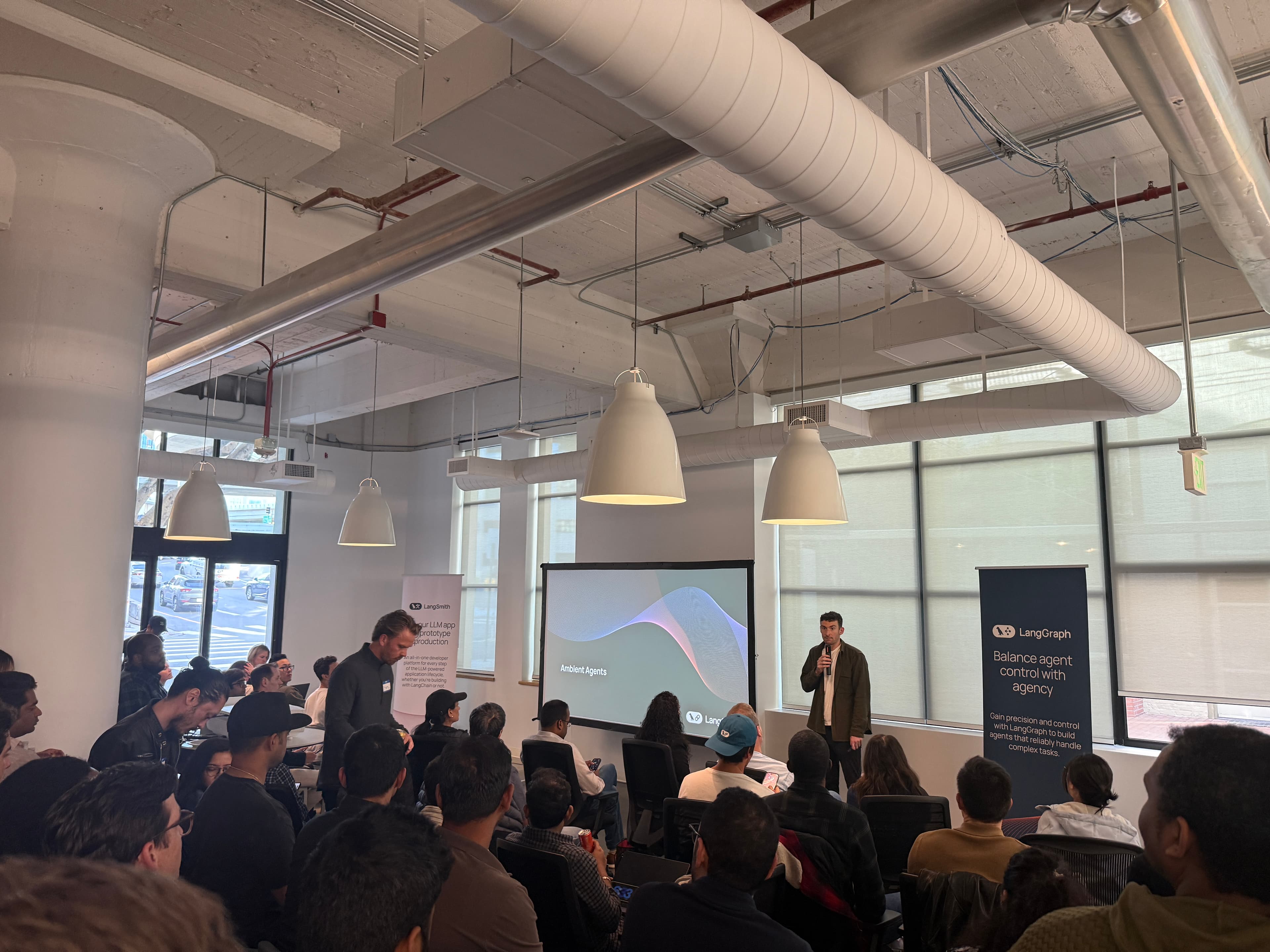
Fast forward to this summer, I was lucky enough to get invited to LangGraph's office to see them present one of their newest frameworks around ambient agents. The idea is simple but powerful: instead of agents you call on for a single task, ambient agents are always on, sitting in the background and ready to act when something happens. In the presentation they described them as event-triggered and asynchronous, meaning they do not just wait for you to type a prompt, but can respond to things like a new commit, a failed test, or even just a calendar event.
The architecture that makes this possible is what stuck with me. Instead of chaining everything together in brittle, hard-coded flows, these agents operate more like decision-makers. They are built to summarize, handle errors explicitly, and know when to stop chasing an unhelpful path. That last part might sound small, but anyone who has tried to get an LLM to do multi-step reasoning knows how easy it is for the model to spiral down a rabbit hole. By giving agents a way to recognize and recover from failure states, the system feels more trustworthy.
One of the demos they showed was Open SWE, basically an ambient coding agent. It hooks into the development workflow and can be triggered automatically by events in a repo. Imagine pushing a commit and instead of just seeing a red X, the agent kicks off in the background, digs into the logs, and gives you a summary of what failed along with a suggested fix. That is a huge shift from the current model where you have to stop everything, parse through error messages, and then go hunting for the cause yourself.
Technically, the "always active" part requires a lot of careful orchestration. You need background processes that can run asynchronously without hogging resources, you need a system for catching errors gracefully, and you need to prevent agents from endlessly looping. They emphasized that summarization is one of the hardest parts. Turning raw logs, diffs, or user actions into something a human can act on is not trivial. But it is also the piece that makes this feel less like automation and more like collaboration.
Thinking about the future, I could see this moving AI away from being a tool you explicitly open and toward being a layer that is just there, woven into whatever you are doing. In software engineering, that could mean agents that quietly track your workflow, run checks in the background, and surface issues before you even notice them. In other domains, it could mean financial dashboards that summarize market shifts the moment they happen, or productivity tools that flag patterns in your day without you having to ask.
The big picture is that ambient agents flip the interaction model. Instead of you always going to the AI, the AI comes to you when it has something useful to say. That requires trust, good design, and a lot of invisible infrastructure. But if it works, it changes how we think about human attention. We could spend less time managing noise and more time making actual decisions.
Thanks to LangChain for inviting me to see the talk and for building such a cool tool! It was inspiring to get a glimpse of what they are working on, and I truly believe these types of agents are the way that LLMs can genuinely change the way we work and even live.